
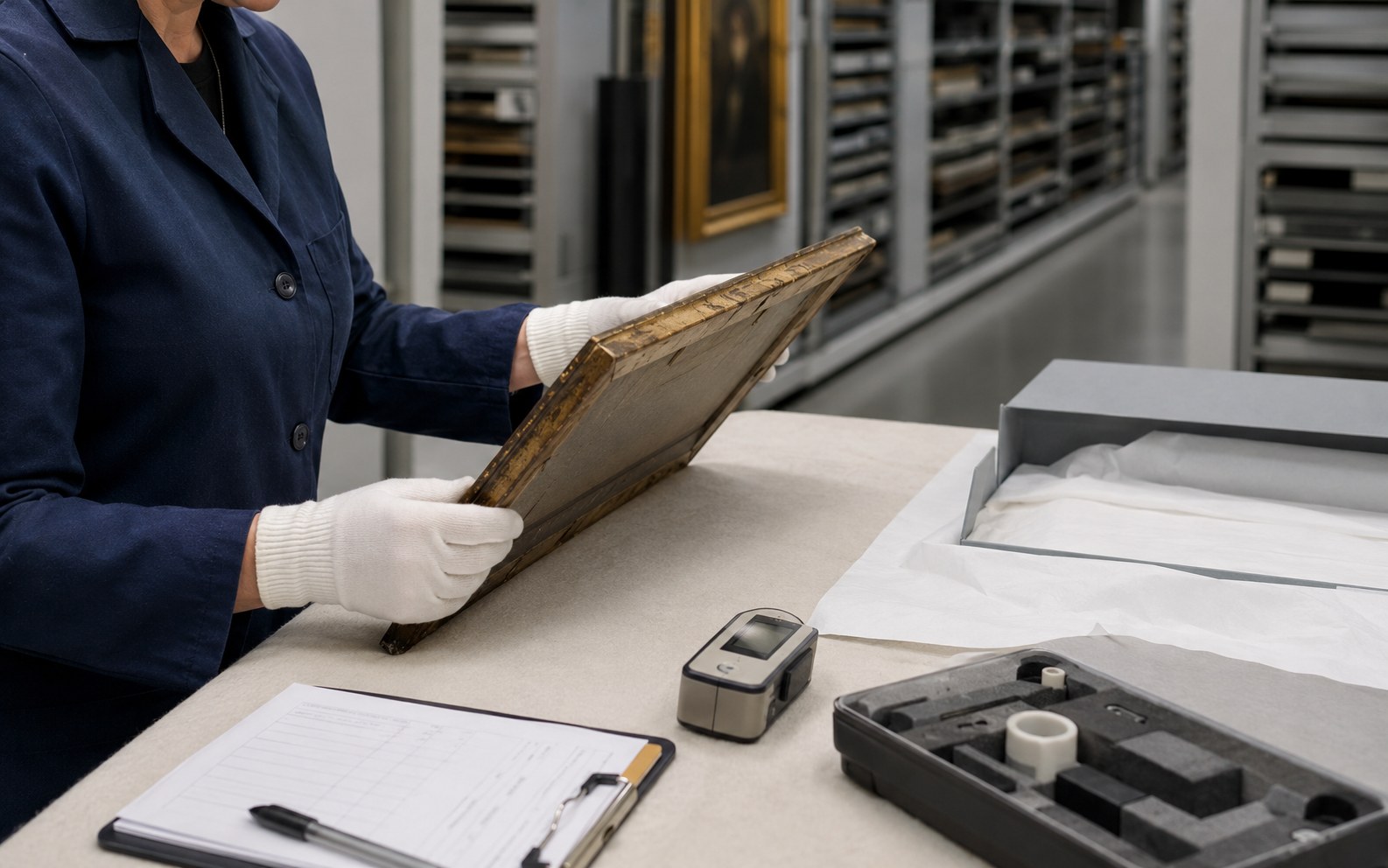
The asset comes before the narrative
Collectibles occupy an unusual place in private wealth. They can be culturally important, personally meaningful and economically valuable at the same time. Those qualities attract expertise and long-term stewardship; they also attract imprecise language, selective price stories and assets whose identity or condition is difficult to establish.
Deloitte’s 2025 Art & Finance Report describes a field in which transparency, valuation, provenance, technology, risk management and the integration of art and collectibles into wealth planning remain central questions.1 That is a better starting point than the claim that collectibles form one homogeneous “asset class”. A painting, a diamond, a vintage watch, a case of wine and a graded card have different markets, evidence and physical risks.
The serious approach is therefore object-specific and process-driven. Before asking what an item might be worth in the future, establish:
- what the item is;
- who owns it and how title passed;
- whether the evidence of authenticity is appropriate for that category;
- its current condition and any interventions;
- where and how it will be held;
- what the insurance policy actually covers;
- how a valuation has been reached;
- what it will cost to hold; and
- who could realistically buy it at exit.
A collectible’s value cannot be separated from the evidence that identifies it and the care that preserves it.
Five records that should never be confused
Provenance
Provenance is the documented history of ownership, custody or circulation. It may support authenticity and marketability, but it is not automatically conclusive. Gaps, unexplained movements, inconsistent dates and unsupported family histories require investigation. For culturally sensitive objects, provenance work may also involve export rules, sanctions, stolen-art databases, restitution questions and the law of the relevant jurisdictions.
Authenticity or attribution
Authentication addresses whether the item is what it is represented to be. The appropriate authority depends on the category. For a gemstone, a recognized laboratory report can describe tested characteristics. For an artwork, authentication may involve catalogues raisonnés, archives, artist foundations, technical analysis and specialist opinion. For a watch, reference and serial information, movement, case, dial and service history may all matter.
No certificate should be treated as universally decisive. The reader should ask who issued it, what was examined, which methods were used, which limitations apply and whether the authority can verify the report independently.
Title
Authenticity does not prove ownership. Title concerns the legal right to transfer the asset. Purchase contracts, invoices, inheritance documents, export or import records, security interests, liens and prior claims may all be relevant. A buyer should know the identity and authority of the seller and receive contractual protections appropriate to the transaction.
Condition
Condition is the physical state of the item at a particular date. It includes damage, restoration, replacement parts, alterations, wear, environmental exposure and packaging. Condition can affect authenticity analysis, insurability, storage requirements and price. It should be recorded before acquisition and when an item moves.
Grade
A grade is a classification produced under a defined methodology. It is not a universal valuation. GIA explains the content and purpose of its gemstone grading reports; PSA provides population data for items graded within its own system.23 The market still determines what buyers pay for a specific object, and grading populations or terminology can change as more items are submitted or standards evolve.
Evidence by collectible category
There is no single due-diligence template, but the following questions establish the correct direction.
Fine art
The file may include attribution evidence, catalogue raisonné references, provenance, exhibition and publication history, invoices, export and import records, condition reports, conservation history and high-resolution images. Auction records and dealer evidence may inform valuation, but a sale result for another work is a comparable—not a price guarantee.
The specialist assessing the work should be appropriate to the artist, period and medium. The person providing a valuation should disclose the purpose, basis, date, assumptions, sources and any conflict. The fact that a work has appeared at auction does not by itself resolve authenticity, title or condition.
Gemstones and diamonds
A laboratory report should be verifiable with the issuing laboratory and matched to the stone. GIA’s report framework records tested characteristics and varies according to the type of gemstone or diamond.2 The report is evidence about the item examined; it is not an appraisal, an insurance policy or a promise of resale value.
The file should also record measurements, weight, treatments where identified, photographs, inscriptions where present, acquisition documents and custody movements. The stone presented at exit must be demonstrably the same stone that was acquired and graded.
Collectible watches
Reference, serial and movement information, case and dial characteristics, provenance, service history, replaced parts, polishing and current mechanical condition may all affect assessment. “Original” should not be used without explaining which components are being described and on what evidence.
Manufacturer extracts, archives and service records can be relevant where available, while specialist and auction-house opinions may assist with comparison. None removes the need for a current physical inspection by an appropriate watch specialist.
Fine wine
Producer, vintage, bottle format, case configuration, tax status, storage history, fill level, label, capsule, cork and signs of leakage or heat exposure can affect acceptability and price. Liv-ex’s Standard in Bond contract illustrates how a professional market defines delivery, original packaging and condition for wine traded under that standard.4 Those rules are a market convention for the relevant Liv-ex contract, not a universal guarantee of quality.
A useful ownership file maintains invoices, warehouse records, condition images and an uninterrupted movement history. “Stored in bond” describes a customs and storage status; it does not by itself prove perfect provenance or condition.
Rare whisky
The analysis differs between bottled whisky and casks. For bottles, producer, bottling, seal, fill level, label, packaging, provenance and signs of tampering matter. The Scotch Whisky Association provides guidance on suspicious products and verification concerns, reflecting the need to test identity rather than rely on presentation.5
Cask interests introduce separate questions about title, warehouse records, ownership transfer, insurance, storage charges, sampling, evaporation, bottling rights and applicable law. A certificate offered by a seller should be checked against the warehouse keeper and the governing records.
Trading cards
The grading service, certification number, grade, label generation, holder condition and population data should be checked with the issuer. PSA explains that its population report counts items graded through PSA and is updated as submissions are processed.3 A population figure is therefore evidence within that system, not a complete count of every surviving example.
High-resolution images and the certification record should be retained. Reholdering, altered cards, counterfeit holders and differences among grading services are separate risks.
Precious metals
For wholesale bullion, the LBMA Good Delivery framework sets technical requirements for bars and accredits refiners whose bars are accepted in the London market.6 “LBMA” should not be used as a decorative quality claim: the refiner, marks, serial number, weight and relevant list status should be verified.
Allocated ownership, bar lists, vault records, inspection rights and insurance are essential. An exposure to metal, an unallocated account and title to identified bars are legally and operationally different.
Sports memorabilia
The file may require league, team or athlete provenance, contemporaneous photographs, match or game-use analysis, chain of custody, signatures and specialist authentication. “Photo-matched”, “game-issued”, “game-worn” and “signed” describe different propositions and should not be used interchangeably.
Because authorities and methodologies vary by sport and object, the evidence provider, scope of opinion and limitations should be disclosed. Cultural significance can support demand, but it is not measurable in the same way as condition or a documented transaction.
Custody is a control system, not an address
Professional custody should be assessed through functions rather than prestige.
Identification and segregation
The custodian’s records should identify the individual object and link it to the owner or structure. Serial numbers, certificates, dimensions, photographs, seals, bar lists, case details or other category-specific identifiers reduce the risk of substitution and support reconciliation.
The agreement should explain whether the asset is held on an allocated, segregated or commingled basis and what those terms mean legally. The owner should understand whether the custodian, a warehouse operator or a sub-custodian has physical possession.
Access and movement controls
Who can enter the storage area? Who can authorize release? Does movement require dual approval? Is every movement time-stamped and imaged? Are shippers and handlers pre-approved? A valuable object is often at greatest risk when it is packed, unpacked, transported, photographed, exhibited or inspected.
Chubb’s fine-art risk framework includes security, fire protection, environmental exposure, inventory management, off-site storage, transportation, conservation and collection valuation among the areas requiring specialist assessment.7 The point is not to copy one insurer’s checklist but to recognize that custody and insurance are connected systems.
Environment and conservation
Different materials react differently to temperature, relative humidity, light, pollutants, pests, vibration and handling. A single “museum-grade” setting is not a meaningful specification. The appropriate range, tolerance and monitoring depend on the object and on professional conservation advice.
ICOM’s international work on museum storage and ICCROM’s preventive-conservation resources both emphasize systematic storage management, documentation, risk assessment and care of collections.89 For a private structure, the practical questions are whether the environment is suitable for the specific item, monitored continuously, reviewed by competent specialists and supported by an incident plan.
Inventory and audit
Periodic reconciliation should compare the legal ownership record, administrator’s participation record and custodian’s physical inventory. Exceptions should be investigated, documented and resolved. Inspection rights, audit frequency, reporting and the treatment of sub-custodians belong in the custody agreement.
Release and exit readiness
Custody is incomplete if the asset cannot be released efficiently for inspection or sale. The file should identify notice periods, outstanding charges, export or tax requirements, packaging, approved carriers, condition reporting and who has authority to sign release instructions.
Insurance: read the policy, not the label
“Fully insured” is not a sufficient description.
AXA XL states the essential limitation clearly: coverage depends on the policy’s terms, conditions and exclusions and on the facts of the individual loss.10 The investor or owner should therefore understand:
- the named insured and the party with an insurable interest;
- the assets and locations scheduled;
- the basis of valuation and any agreed values;
- deductibles, limits and sub-limits;
- territorial and transit coverage;
- exclusions, warranties and security conditions;
- treatment of gradual deterioration, inherent vice and restoration;
- notification and claims procedures;
- the insurer and policy period; and
- how proceeds are allocated within the investment structure.
Purchase price, market-value estimate, replacement value and an agreed insured value are different concepts. The appropriate basis depends on the asset and policy. Values should be reviewed when material market evidence, condition or ownership changes—not because every appraisal will be realized in a sale, but because stale schedules can create underinsurance or unnecessary premium.
Insurance also does not restore the cultural or market position of an asset. A repaired object may be worth less than before damage, and a policy may treat restoration cost and diminution in value separately or exclude part of the loss. The wording controls.
Valuation: an opinion with a purpose and a date
An appraisal is not a live bid.
RICS’s global valuation standards, incorporating International Valuation Standards, require clarity about scope, basis of value, information, assumptions, methodology, reporting and independence.11 Those principles are particularly important in collectible markets where transactions may be private, objects are heterogeneous and the most visible auction result may be an unsuitable comparable.
A credible valuation report should state:
- Purpose: acquisition, financial reporting, insurance, tax, financing or prospective sale.
- Subject: the precise object and identifiers examined.
- Effective date: the date at which the opinion applies.
- Basis of value: the defined premise being used.
- Evidence: transactions, asking prices, dealer evidence, indices or other data reviewed.
- Adjustments: differences in artist, model, rarity, condition, size, provenance, grade, packaging, location, fees and date.
- Assumptions and limitations: inspection limits, unavailable records, uncertain attribution or restricted data.
- Independence and competence: the appraiser’s relevant expertise and conflicts.
Where evidence is thin, a range or scenarios may be more honest than a single point. The acquisition case should distinguish hammer price, buyer’s premium, tax, shipping, storage, insurance and eventual selling costs. A market can rise while a specific investor still loses money because the selected object, entry price, condition or cost burden was wrong.
Carrying costs and the economics of patience
Physical assets incur costs whether or not the market is favorable. They may include authentication, legal and tax work, buyer’s premium, transport, customs, storage, conservation, insurance, administration, revaluation and selling commission.
Those costs affect selection in two ways. First, a lower-value object can be uneconomic to hold if fixed annual charges consume too much of its value. Second, high recurring costs reduce the ability to wait for an appropriate buyer. The asset may be culturally compelling and still be structurally unsuitable for fractional participation.
A complete investment case should show gross acquisition price, all entry costs, expected annual costs under stated assumptions, contingency allowances and exit costs. It should not convert an appraisal into an expected return.
Exit begins before acquisition
Collectible markets do not provide one continuous pool of demand. The likely buyer for a museum-quality painting is not the same as the buyer for an unopened case of wine or an allocated bullion bar. Exit planning begins by identifying the natural market and its requirements.
Questions include:
- Which auction houses, dealers, exchanges or private buyers handle the category?
- What condition, certification, packaging, lot size and provenance do they require?
- Is the asset suitable for public auction, private treaty, dealer sale or an organized professional venue?
- How long can preparation, consignment, compliance, shipping and settlement take?
- What commissions, taxes and other deductions apply?
- Who decides whether to accept a bid?
- What happens if reserve expectations are not met?
An intended holding period is a planning assumption. A credible structure can explain the route and decision process; it cannot guarantee the timing, buyer or price.
A due-diligence file that can survive the holding period
For each asset, the file should be capable of moving with the object and supporting a future buyer’s review. It may contain:
- purchase agreement and invoice;
- seller identity and title evidence;
- provenance and ownership history;
- authenticity, laboratory or grading reports;
- export, import and tax documents;
- condition report and high-resolution images at acquisition;
- restoration, service or conservation history;
- custody agreement and precise storage location;
- movement and inspection log;
- insurance policy, schedule and valuation basis;
- independent valuation reports and underlying evidence;
- reconciliations among owner, administrator and custodian records;
- periodic condition and environmental reports; and
- exit correspondence, consignment and sale records.
Good custody preserves the object. Good documentation preserves the ability to prove what the object is.
Frequently asked questions
- What is the difference between provenance and authenticity?
- Provenance is the documented history of ownership or custody. Authentication is the assessment of whether the item is what it is represented to be. They can support each other but are not the same.
- Does a grading certificate establish value?
- No. It records an assessment under the issuing organization’s methodology. Value also depends on the object, market, condition, rarity, provenance, timing, costs and buyer demand.
- What does professional custody mean?
- It should mean documented identification, appropriate physical storage, controlled access and movements, environmental and security measures suited to the item, inventory reconciliation, incident procedures and a clear release process. The exact controls differ by category.
- Is an asset safe because it is stored in a free port or bonded warehouse?
- Not automatically. Customs status and facility location do not replace review of title, operator, segregation, security, environment, insurance, access, audit and release rights.
- Should insurance be based on purchase price?
- Not necessarily. Policies use defined valuation bases and may schedule agreed values. The appropriate amount and method should be set with the insurer and qualified advisers and reviewed as facts change.
- How often should a collectible be valued?
- There is no universal interval for every category and purpose. The policy should reflect market activity, reporting needs, insurance terms, material events and cost. Every valuation should have a stated effective date and limitations.
- Can tokenization make a collectible easier to sell?
- It may improve administration of fractional interests, but it does not create demand for the object or guarantee a buyer for the interests. Transfer rules, investor eligibility, documentation and the underlying exit market remain decisive.
- What is the greatest avoidable risk?
- Treating identity, title, condition, custody, insurance and valuation as separate workstreams. A weakness in one can undermine all the others.
Editorial conclusion
The culture around collectibles can be expansive; the process around them should be exact. The strongest structures preserve both sides. They respect the object’s history and material character while maintaining the records, controls and economic discipline required for someone else to verify it years later.
This guide is educational and does not constitute investment, legal, tax, valuation or insurance advice, an offer or a solicitation. Collectible values can fall, markets can be illiquid, appraisals may not be realized and insurance may not cover every loss. Decisions require the documentation of the specific asset and advice from qualified specialists.