
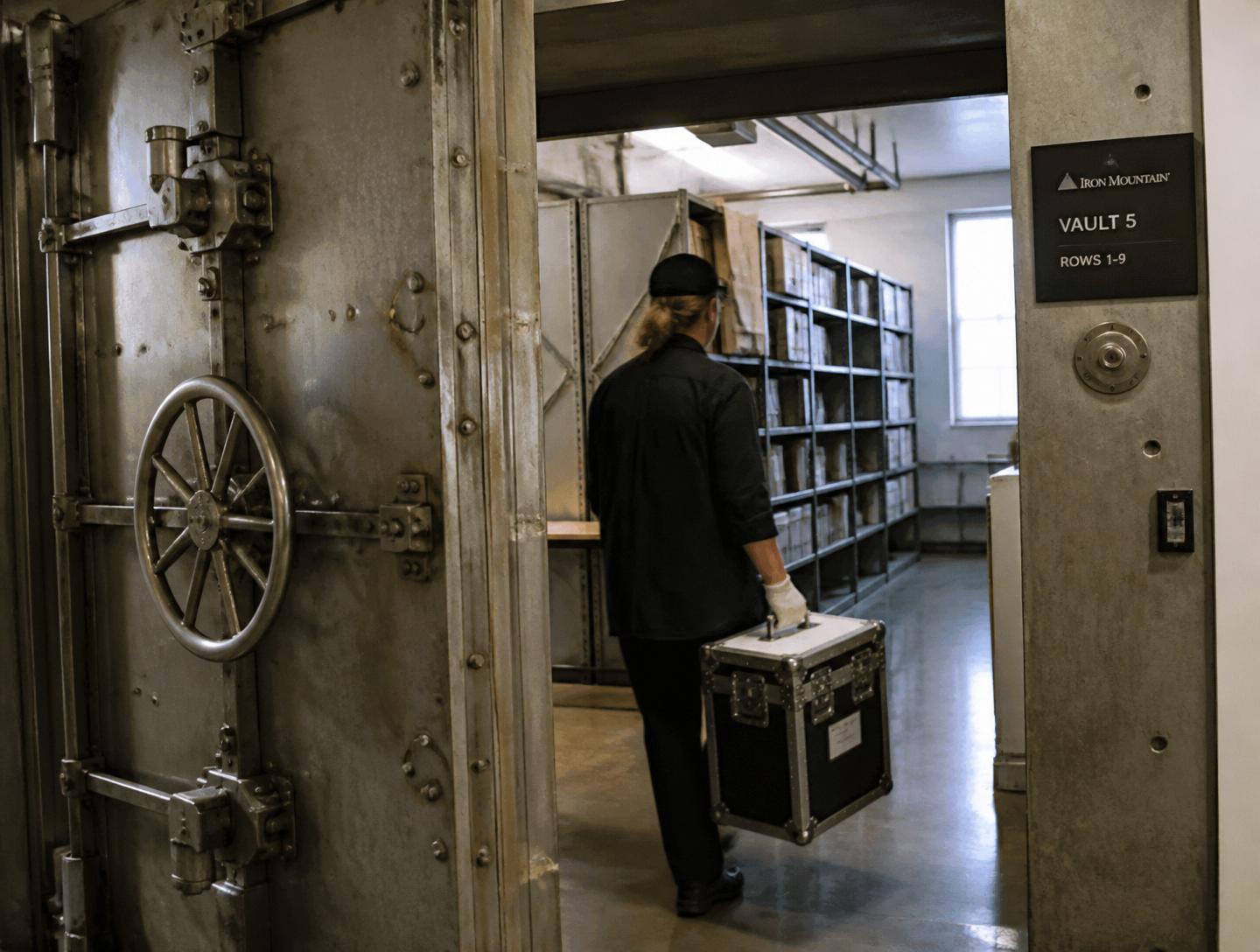
Collectible assets carry physical risk. Their value depends on condition, authenticity and provenance — three qualities that can be damaged in a single afternoon of careless handling. Professional custody is what allows a beautiful object to be treated as an investable asset, and it is one of the least visible components of every opportunity we structure. It is also one of the first subjects a sophisticated investor raises.
Custody is a chain, adapted to each class
Custody is not one service but a set of arrangements adapted to the asset. Fine art requires climate-controlled storage, documented handling protocols, conservation-grade materials and specialist transport. Wine and whisky are typically held in bonded warehouses under excise supervision, where temperature and humidity discipline protects years of maturation. Investment-grade gemstones and precious metals are held in high-security vaults, and metals in certified form, because certification is what makes a bar readily marketable. Graded trading cards remain sealed in their tamper-evident holders under controlled conditions, since the grade is inseparable from the value. Sporting memorabilia asks for stable humidity and temperature to keep fabrics, signatures and materials intact. Specialist custody facilities provide asset-specific storage and handling arrangements across these classes.
Insurance that follows the appraisal
Storage without insurance is half a solution. Each asset is insured at its professionally appraised value, and where valuations are refreshed by independent experts, cover is intended to follow the current appraisal rather than a historic entry price. The detail deserves emphasis: an asset that has appreciated but remains insured at its acquisition value is under-protected precisely where protection matters. The treatment of insurance proceeds in the event of damage, loss or theft is set out in the documentation of each operation, in proportion to documented holdings.
Custody discipline shapes selection
Custody also disciplines what we admit in the first place. Storage and insurance need to remain a modest, predictable fraction of asset value per year; an object whose holding costs are disproportionate to its realistic prospects fails our selection criteria however attractive it looks in a catalogue. Custody feasibility is assessed before an asset is accepted. And because participants in a fractional co-ownership never handle the object themselves, the custody chain is also what makes shared ownership practical.
Questions worth asking any operator
Where exactly is the asset held, and under whose agreement? Insured by whom, for how much, and updated on what basis? Who may access it, and under which protocol? What happens at exit — who releases the asset, against which documentation? We answer these questions asset by asset, and the general framework is set out in our guide to custody, insurance and valuation.